
Washington Behavioral Medicine Associates offers TMS therapy in Chevy Chase, MD for adults with treatment-resistant depression, anxiety, and OCD – under the direct supervision of a board-certified psychiatrist.





TMS – short for transcranial magnetic stimulation – uses focused magnetic pulses to stimulate specific areas of the brain involved in mood regulation. The FDA first cleared TMS for major depressive disorder in 2008, and clearances have since expanded to include OCD and smoking cessation.
During a session, a device placed near your forehead delivers brief magnetic pulses to the prefrontal cortex. These pulses activate nerve cells in brain regions that tend to show reduced activity in people experiencing depression. You remain awake and alert the entire time – no anesthesia, no sedation, no recovery period afterward.
That last point matters more than it might seem. Unlike electroconvulsive therapy (ECT), TMS does not require general anesthesia or cause seizures. Most patients drive themselves to and from appointments and return to their normal routine immediately after each session. The distinction between TMS and ECT is one of the most common questions we hear, and it is worth understanding before making a treatment decision.
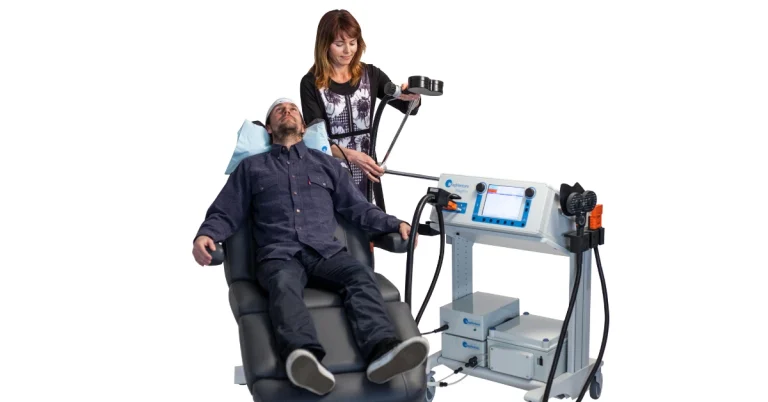
TMS therapy is most often recommended for adults who have not responded adequately to at least one antidepressant medication. Clinicians sometimes refer to this as treatment-resistant depression – though “resistant” can be misleading. It does not mean your condition is untreatable. It means the first-line approaches did not work well enough, and a different mechanism of action may help. Conditions where TMS has shown clinical promise include:
The primary FDA-cleared indication, backed by extensive clinical trial data.
Depression with significant anxiety - difficulty with both mood and ongoing worry.
FDA-cleared for OCD when standard treatments have not been sufficient.
Patients who have tried two or more medications without adequate improvement.
**TMS is not appropriate for everyone. Metal implants in or near the head rule it out, with dental fillings the usual exception. A history of seizures or certain neurological conditions calls for a closer look, and bipolar disorder needs screening for treatment-emergent mania.
Coverage through Brain Modulation Services (BMS)


Insurance coverage is available through Brain Modulation Services (BMS), a WBMA-affiliated practice. Coverage varies by plan, diagnosis, and service type. Not all services are covered.
The first appointment is longer than the rest – typically 60 to 90 minutes. During this initial session, your psychiatrist maps the exact treatment location on your scalp and calibrates the magnetic pulse intensity to your individual motor threshold. This calibration step is what separates a carefully administered TMS protocol from a generic one. After that first mapping session, each subsequent appointment follows a predictable rhythm.

Your first visit (60-90 min) maps the exact treatment location and calibrates pulse intensity to your individual motor threshold.
Each session delivers pulses for about 19 to 37 minutes while you sit comfortably. You remain awake and alert throughout.
You stand up and leave - back to work, errands, or daily life with no restrictions or recovery period.
The full course: 5 days per week for 4 to 6 weeks (roughly 20 to 36 sessions). Some patients notice changes within the first two to three weeks, though the full benefit of TMS often becomes apparent after completing the entire course, according to the National Institute of Mental Health.
FDA-cleared for depression
See meaningful improvement*
Achieve full remission*
Seizure risk (very rare)
*Based on a 2019 meta-analysis in the Journal of Clinical Psychiatry of treatment-resistant depression patients. Individual results vary.
Cost is one of the most practical concerns patients raise – and it deserves a direct answer. TMS therapy is covered by most major insurance plans when prescribed for FDA-cleared indications, particularly treatment-resistant depression. Coverage has expanded significantly over the past several years as the evidence base has grown.
At WBMA, our administrative team verifies your insurance benefits before treatment begins so you understand your out-of-pocket responsibility upfront. We work with a range of commercial insurers, and many patients find that TMS is covered similarly to other outpatient psychiatric procedures once prior authorization criteria are met.
For patients without insurance coverage or those pursuing TMS for off-label indications, we offer transparent self-pay pricing discussed during your initial consultation. The total cost depends on the number of sessions prescribed and the specific protocol used.
Both target brain activity to treat depression, but they differ meaningfully in mechanism, intensity, and side-effect profile.
Your treatment is overseen by board-certified psychiatrists with deep neuromodulation expertise – not delegated to a technician working from a script.






Several psychiatric practices in the Washington DC area offer TMS. Choosing the right provider matters – the technology is only as effective as the clinical judgment guiding it.
At WBMA, TMS is part of a broader neuromodulation program integrated within a full-service psychiatric practice. Your TMS psychiatrist also has access to your therapy records, medication history, and neuropsychiatric testing results – all under one roof. Most standalone TMS clinics cannot offer that continuity.
Dr. Gonzalo Laje, WBMA’s founder and medical director, is a double board-certified psychiatrist with advanced training at the National Institute of Mental Health and 57 peer-reviewed publications in treatment optimization and pharmacogenetics.

Depression that has not responded to medication does not mean you are out of options. We begin every TMS conversation with a thorough psychiatric evaluation – because the right treatment starts with the right diagnosis. If you or a family member are considering TMS in the Chevy Chase, Bethesda, or greater Washington DC area, we are here to help.
Individual results may vary. Treatment effectiveness depends on each patient’s unique circumstances.
TMS therapy is generally not painful for most patients. The magnetic pulses produce a tapping or knocking sensation on the scalp during treatment, and some patients experience mild discomfort during the first few sessions that typically diminishes as the scalp adjusts.
In clinical studies, fewer than 5% of patients discontinued TMS due to discomfort – a lower dropout rate than many oral antidepressant medications. Most patients at our practice describe the sensation as unusual rather than painful.
If you are concerned about discomfort, your psychiatrist can adjust pulse intensity during the initial mapping session. Schedule a consultation to discuss what the experience feels like in detail.
A standard TMS treatment course consists of 20 to 36 sessions delivered over 4 to 6 weeks, with sessions scheduled 5 days per week. Each individual session lasts approximately 19 to 37 minutes depending on the protocol selected by your psychiatrist.
Newer accelerated protocols – sometimes called theta burst stimulation – can deliver effective treatment in shorter individual sessions, though the total course length remains similar. Your psychiatrist determines which protocol aligns with your clinical needs and schedule.
Many patients fit TMS sessions into a lunch break or before work without significant disruption to their daily routine.
TMS side effects are generally mild and localized. The most commonly reported side effects include scalp discomfort at the treatment site, mild headache during or after sessions, and temporary lightheadedness. These effects typically resolve within the first week of treatment as patients adjust to the magnetic stimulation.
Serious side effects are rare. The most significant risk – seizure – occurs in fewer than 0.1% of patients, according to data reviewed by the FDA. For context, that risk is comparable to or lower than the seizure risk associated with many commonly prescribed antidepressant medications.
Read our detailed guide on TMS therapy side effects for a full breakdown of what clinical research has documented.
TMS therapy is covered by most major commercial insurance plans for the treatment of major depressive disorder when prior authorization criteria are met. Coverage typically requires documentation that the patient has not responded adequately to at least one antidepressant medication trial.
Insurance coverage for TMS has expanded substantially since 2015 as clinical evidence has accumulated. Medicare and many Medicaid plans also provide coverage in qualifying cases, though specific requirements vary by state and plan.
Our team at WBMA handles insurance verification and prior authorization before your first session so there are no surprises. Contact our office to check your specific coverage.
TMS and ECT (electroconvulsive therapy) both target brain activity to treat depression, but they differ in mechanism, intensity, and side effect profile. TMS uses focused magnetic pulses without anesthesia, sedation, or induced seizures. ECT delivers electrical currents under general anesthesia to produce a brief, controlled seizure.
ECT is generally reserved for severe, acute cases where rapid response is critical – such as active suicidal ideation or catatonia. TMS is typically recommended earlier in the treatment-resistant pathway, before ECT becomes necessary. The cognitive side effects also differ meaningfully – ECT commonly causes short-term memory disruption, while TMS has not been associated with significant cognitive side effects in clinical research.
Your psychiatrist can help you understand which approach may be more appropriate based on your clinical history and symptom severity. Learn more about how TMS works.
Response timelines vary by individual, and research supports that TMS benefits often become most apparent after completing the full treatment course. Some patients report subtle improvements in sleep, energy, or concentration within the first two weeks, while significant mood changes more commonly emerge around weeks three to four.
A 2019 meta-analysis published in the Journal of Clinical Psychiatry found that approximately 50% to 60% of TMS patients with treatment-resistant depression experienced meaningful symptom improvement, with about one-third achieving full remission. Those numbers are notable for a population that had already failed one or more medication trials.
Your psychiatrist tracks your progress throughout the course and can adjust protocol parameters based on your response pattern.

All health-related information contained within this Blog/Web site is intended to be general in nature and should not be considered as a substitute for the advice of a personal healthcare provider. The information provided is for educational purposes only, designed to help patients and their families wellbeing.
Always consult your health care provider regarding medical conditions, treatments and health needs of you and your family.
In an emergency situation call 911 or go to your nearest emergency room.